

Unruly Doctrine ·
A Classroom Is Not a Throne
On the performance of authority, the dignity of education, and the power of the pen.

Last week, I scored a 106 on my examination. I was proud of that. I celebrated it because I understood what it took for me to sit in that classroom, concentrate, retain information, and perform at that level while living with a neurological illness that has fundamentally altered the course of my life. I wasn’t looking for applause. I wasn’t expecting anybody to understand. I was simply proud of myself for accomplishing something that might seem ordinary to someone who doesn’t have to fight his own brain just to make it through another day.
This week, I suffered several seizures. I live with chronic pain, neurological instability, exhaustion, and the uncertainty of never knowing when my own body might betray me. And as if that weren’t enough, a man was shot and robbed right in front of my apartment this same week. Another reminder of how quickly life can change, how close violence can come to the place you’re supposed to feel safe, and how little control any of us truly have over the world outside our door.
And still, I got up and went to school.
I didn’t walk into that classroom announcing my suffering. I didn’t ask anybody to feel sorry for me. I didn’t tell the instructor about the seizures or the violence outside my home. I didn’t demand special recognition because I was carrying things that other people couldn’t see. I arrived, opened my books, completed my assignments, and continued pursuing my education. Because that’s what I’ve spent my entire adult life learning to do. Keep moving when the body hurts. Keep learning when the brain struggles. Keep believing in a future even when the present seems determined to take everything out of you.
There is something deeply unsettling about watching a grown man confuse his position of authority with the right to diminish another human being. Especially young people. Especially inside a classroom, where the entire purpose of an instructor is supposed to be the transmission of knowledge, not the preservation of his own ego.
For some time now, I’ve observed an instructor who seems to expect students to arrive already knowing the material they’re paying to be taught. I’ve watched him roll his eyes when younger students ask perfectly reasonable questions. I’ve seen him respond to confusion with visible irritation, distribute paperwork, play YouTube videos, and sit back while the students attempt to piece together information that should have been explained to them. He’ll hand out thirty questions and give the class fifteen minutes to grade them, as though the speed of the exercise somehow compensates for the absence of meaningful instruction.
I have no problem with independent study. I believe students should be challenged. I believe young people need to develop discipline, critical thinking, and the ability to solve problems without somebody holding their hand through every difficulty. But there is an enormous difference between challenging a student and abandoning the responsibility to teach them. There is an even greater difference between correcting someone and deliberately making them feel small.
Some of these students are barely 18 years old. My oldest son’s age group. They’re still discovering who they are, what they’re capable of, and what kind of future they want to build. Most are Black, but I have enough words for several books to talk about the added pressures on them. They’re supposed to ask questions. They’re supposed to make mistakes. They’re supposed to encounter things they don’t understand, because that’s precisely why they’re sitting in a classroom.
And I’m sitting there as a Dad in his 40s, watching the same behavior that I would never want my own children to experience from someone entrusted with their education.
I’m raising men. My oldest son is already attending college and building his future without the weight of student loans. I’ve spent years trying to teach my children that knowledge is something to pursue relentlessly, that curiosity should never be punished, and that respect for an educator should never require surrendering their dignity. When I see young people being treated like inconveniences for wanting to understand something, I don’t simply see a frustrated instructor. I see how easily an adult can discourage a young person from pursuing something they might otherwise have grown to love.
We complain endlessly about the next generation. We call them distracted, entitled, impatient, and unwilling to learn. Yet some of the very people responsible for preparing them for the future appear irritated by the actual process of education.
How can you demand competence from someone while resenting the questions required to develop it?
And why does asking for clarification sometimes provoke more hostility than refusing to participate at all?
I respect the craft. I respect the trade. I respect the years of physical labor, sacrifice, repetition, discipline, and experience required to become proficient in something. I’ve spent enough of my own life learning difficult things to understand that mastery is not acquired overnight. I have no interest in diminishing another man’s professional accomplishments simply because I disagree with his conduct.
But I am not intimidated by the number of years another man has worked in his profession. His experience may deserve recognition, but it doesn’t place his humanity above mine. A résumé can tell me where someone has worked. A title can tell me what authority an institution has given him. Neither tells me whether he possesses the patience, humility, emotional discipline, or character required to treat another person with dignity.
And when I look at certain behavior, I don’t see strength. I see what appears to me to be insecurity disguised as authority.
That’s not my burden to carry.
I’ve observed the attention to appearances, the need to command a room, the jokes and remarks about women that make me question the maturity behind the performance. I’ve listened to comments that, in my view, cross the line between appreciating women and reducing them to objects of entertainment. I love women. I admire their beauty, intelligence, independence, and presence. I’m not going to pretend that attraction isn’t part of being human. But there is a difference between attraction and disrespect, and I refuse to participate in the idea that masculinity requires turning women into subjects of constant sexual commentary.
I’ve never needed to compete with another man for attention from women. I don’t need to be the loudest voice in a room, manufacture an image, or collect approval from people around me to feel secure in who I am. I’m comfortable in my own skin. I can enter a room quietly, carry myself with confidence, and engage with people without needing to remind them of my importance.
And I think there’s something revealing about how certain men react to that kind of independence.
I can’t tell you what’s happening inside another person’s mind. I don’t know whether envy, resentment, or insecurity motivates his behavior toward me. But I’ve seen enough passive aggression throughout my life to recognize when a situation no longer feels like ordinary disagreement. I’ve witnessed the little remarks, the dismissive expressions, the attempts to establish superiority in conversations that never needed to become competitions.
I’ve refused to participate in social circles or rituals that conflict with my convictions. I’m a man of God, and my beliefs aren’t something I set aside simply to belong to a group. I have no desire to buy acceptance through conformity, and I don’t need anyone’s approval to establish my own identity.
If that makes someone uncomfortable, I cannot spend my life managing their discomfort.
I’m Black and grown. I grew up in Peekskill, New York. My family’s from Yonkers. I’ve served my country, navigated oceans, traveled through different parts of the world, and encountered people from backgrounds that forced me to reconsider everything I thought I understood about humanity. I’ve buried people I love. I’ve experienced fatherhood, loss, illness, isolation, and the long process of rebuilding a life when the world refuses to stop moving around you.
I’ve also spent years living with a neurological condition that has repeatedly reminded me how fragile the human body can be. I’ve endured seizures alone, woken up in pain, struggled with memory, and sat in medical appointments answering questions about who witnessed my last episode. There are moments when doctors ask whether someone was there with me, and I have to tell them nobody was. Sometimes I watch their expressions and wonder whether I’m looking at concern, sadness, or disbelief that a man could be enduring so much of his life alone.
There are mornings when getting out of bed is an accomplishment nobody will ever celebrate. Days when my legs hurt, my mind feels exhausted, and the uncertainty surrounding another seizure makes even the simplest plans difficult.
But I keep moving.
Not because I’m invincible. Not because I don’t feel fear, frustration, or loneliness. But because I have kids who deserve to watch their father continue living, learning, building, and creating beyond his suffering. Because I still have a Mama who loves me, people who believe in me, and work that I intend to leave behind long after my body has returned to Mother Earth.
I don’t announce these things every time I enter a classroom. I don’t need anyone to salute my military service or acknowledge what I’ve survived. I’m there to learn, just like everybody else.
And that was the man this instructor chose to belittle.
Today, what had been accumulating beneath the surface finally became a confrontation.
I’d scored a 106 on an examination the previous week. This same instructor had spoken about appreciating his students and recognizing those who performed well by writing their names on the board. My name was among them, and I remember it clearly because I’d taken a photograph that day.
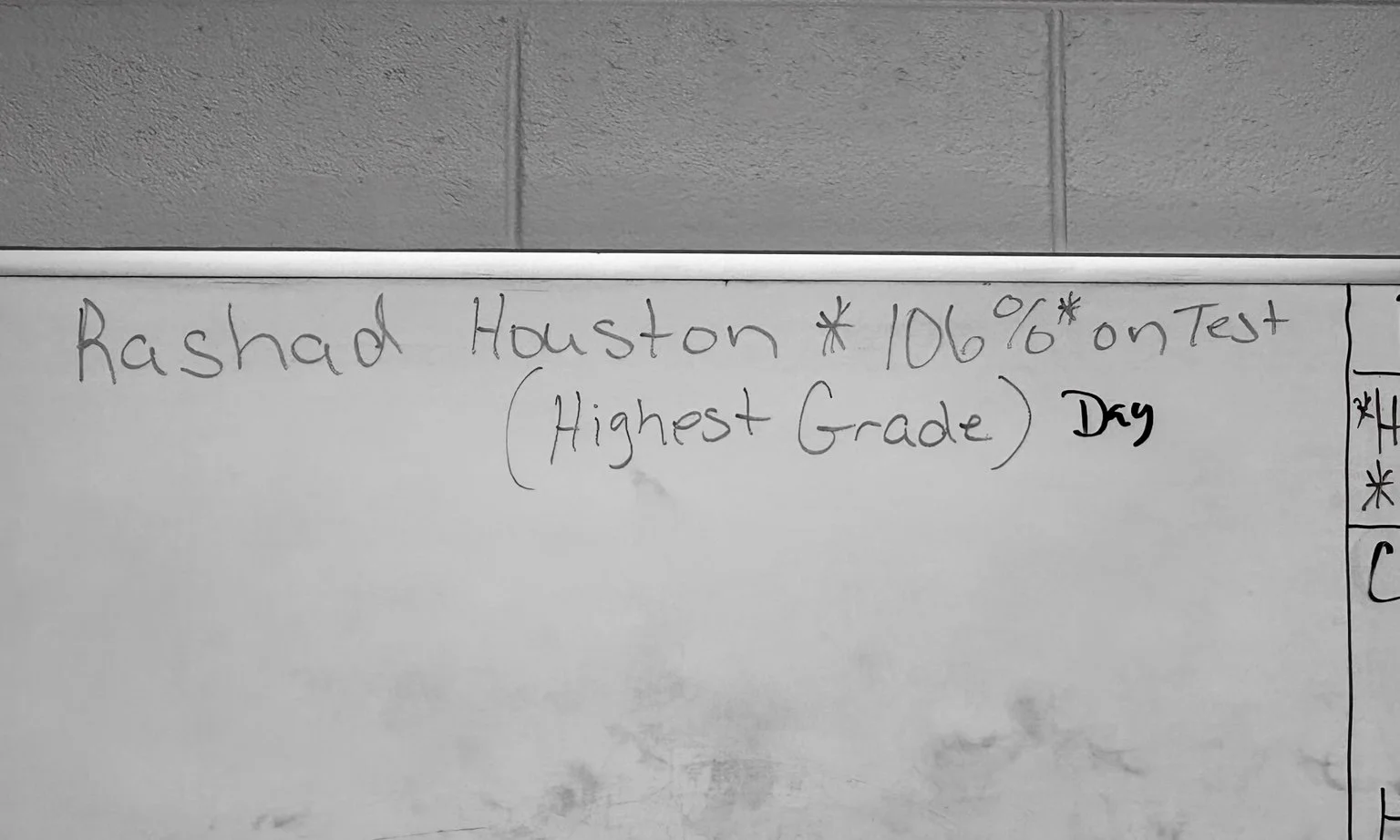
Yet he’d repeatedly addressed me by the wrong name.
My name is Rashad.
I don’t believe a man should have to continuously defend something as basic as his own name. People make mistakes, and I’ve never expected perfection from another human being. But when someone claims to appreciate their students while failing to make the effort to address one of them correctly, especially after publicly recognizing his academic performance, that contradiction deserves to be questioned.
During our exchange, I reminded him that he’d written my name on the board.
He denied it.
I told him it was right there and that I’d even taken a photograph. Didn’t he remember?
Then suddenly, he did.
“Oh, I remember now.”
And he became quiet.
It was such a small moment, but it revealed something that had been bothering me for weeks. Here was someone who seemed to expect constant acknowledgment of his own professional background while struggling to extend the simplest acknowledgment to someone sitting directly in front of him.
I wasn’t asking for special treatment. I was asking to be addressed with the same basic respect that any human being deserves.
The conversation continued, and at one point he told me, “You go low, I can go lower.”
Think about that statement coming from someone responsible for educating students.
I told him I had the power of the pen.
His response was that he had something more powerful than that.
And those words changed the nature of the exchange for me.
I cannot speak to what he intended, but I know how I received them. I heard an implication of intimidation, and I take that seriously. I’m a father. I don’t exist in isolation. My decisions, my safety, and the consequences of anything that happens to me extend into the lives of the people I love. My children don’t stop needing their father because another man decides he wants to establish dominance during a disagreement.
I have a responsibility to protect my life, my peace, and my family. That responsibility requires judgment, restraint, and the ability to recognize when a situation is becoming unnecessarily hostile.
But protecting myself does not mean surrendering my voice.
I didn’t need to scream at the top of my lungs. I didn’t need to threaten him in return. I stood my ground and made it clear that I would not continue accepting disrespect simply because I’m ordinarily a quiet person. My confidence wasn’t something I had to manufacture for that moment. It was already there, built through years of experiences he knows absolutely nothing about.
I watched his demeanor change as I challenged him directly. From where I stood, the certainty he’d displayed when dismissing others seemed far less secure once someone refused to accept the treatment.
There is a difference between demanding obedience from young people and engaging another adult who knows his own worth. A position of authority might allow a man to direct a classroom, but it cannot compel another human being to admire his character.
I became angry. I called him a sucker, and I’m not going to remove that part of the story to make myself sound more polished. I’m a human being. I have emotions. I can be pushed too far, and I can recognize afterward when my words became sharper than they needed to be.
But accountability doesn’t require pretending that the behavior preceding my reaction never happened.
I can examine my anger without abandoning the reasons behind it.
What I refuse to accept is the idea that my quiet nature gives another man permission to walk all over me. Silence is not submission. Patience is not weakness. Restraint is not fear. And someone who has learned to survive suffering without constantly announcing it should not be mistaken for someone incapable of defending his dignity.
I’ve spent years developing a confidence that doesn’t depend on dominating other people. I don’t enter a room looking for men to challenge. I don’t measure myself against their clothing, titles, salaries, or accomplishments. I have my own life, my own faith, my own responsibilities, and my own understanding of who I am.
I know what I bring into a room, whether anyone acknowledges it or not. And I know what I’ve endured just to arrive there.
There is a particular kind of strength that develops when suffering becomes part of your daily existence. You stop being impressed by performances of power because you’ve encountered realities far more consequential than another man’s ego. You’ve seen what illness can do to the human body. You’ve watched people die. You’ve experienced moments when all the titles, expensive clothing, professional recognition, and social approval in the world meant absolutely nothing.
Pain has a way of stripping life down to its most essential truths.
Are you going to get up?
Are you going to continue?
Are you going to allow what happened yesterday to dictate the entirety of your tomorrow?
For me, those questions have become far more important than whether another man approves of how I carry myself.
I believe the strength that allows me to continue comes from the highest point I can’t even fathom. An infinite light guides me in dark times. I don’t say that because I believe I’m morally superior or immune to failure. I’ve failed in countless ways. I’ve made mistakes, hurt people and struggled against parts of myself that required years of reflection. But my faith has given me a foundation that doesn’t disappear when someone attempts to humiliate me.
There is a lion inside me. There always has been.
But I’ve never believed a lion needs to roar at everything that moves to prove its existence. Real strength is not an endless performance of aggression. Sometimes it’s having the capacity to respond forcefully and choosing restraint. Sometimes it’s speaking firmly when everyone expects you to remain quiet. And sometimes it’s recognizing that another man’s insecurity has absolutely nothing to do with you.
I have nothing to prove to someone who mistakes belittling people for leadership.
What concerns me most about today’s events isn’t what happened between two grown men. It’s what these encounters teach the younger students watching them unfold.
What happens to a kid who repeatedly sees his questions met with contempt? What happens to the student who begins believing that confusion is evidence of stupidity rather than a natural part of learning? How many young people abandon a profession they might have loved because the person assigned to teach them made the learning process feel like a punishment?
We live in a society constantly discussing labor shortages, declining educational outcomes, failing institutions, and the urgent need for a new generation of skilled workers. We spend enormous amounts of money advertising opportunities for young people to enter technical fields and demanding that they become productive members of society. Yet we sometimes overlook the human beings standing directly between those young people and the knowledge they’re trying to acquire.
Education isn’t supposed to be a theater of humiliation. It’s supposed to be a bridge.
And anyone entrusted with building that bridge has a responsibility to remember that the people crossing it are not beneath them simply because they haven’t yet reached the other side.
I have learned from remarkable men and women throughout my life. Some were military leaders. Some were teachers, tradespeople, parents, strangers, and people who never possessed a prestigious title in their entire existence. The people who taught me the most weren’t necessarily the ones who demanded the greatest respect. They were the ones whose knowledge was accompanied by patience, whose experience was evident in their conduct, and whose strength made other people feel capable of becoming stronger themselves.
That’s the kind of man I want my sons to become.
Not a man who needs to remind everybody of his importance, but one whose presence reflects his convictions. Someone who understands that a younger person’s ignorance is not an invitation for ridicule. Someone who can admire a woman without reducing her to an object. Someone who knows when to stand firm, when to listen, and when to admit that he has more to learn.
And I want them to understand that even their father is still learning those lessons.
I’m not above criticism. I’m not beyond making mistakes. My experiences don’t make me automatically right, and my suffering doesn’t grant me permission to mistreat another human being. I understand that. What I will not do is allow another person’s conduct to convince me that I deserve less respect because I refuse to participate in his performance of authority.
There is a tremendous difference between humility and humiliation. I choose humility. I reject humiliation.
After everything I experienced this week, I could have stayed home. I could have surrendered to the exhaustion, the pain, the anxiety, and the uncertainty. I could have allowed the violence outside my apartment to become another reason to retreat from the world. I could have looked at my medical condition and decided that pursuing another educational opportunity at this age simply wasn’t worth the effort.
Instead, I went to school. I studied. I completed my work. And I had a 106 on my examination to celebrate.
That achievement means something to me because I know how much of my life remains invisible to the people around me.
And perhaps that’s the greater lesson I want to leave behind. You never know what another person is carrying.
The quiet man sitting beside you might have spent the morning recovering from a seizure. The woman across the room might be grieving someone she buried yesterday. The young student asking a question might be working two jobs, caring for a sick parent, or trying to become the first person in his family to earn a credential. The person you dismiss as unintelligent might have fought an invisible battle just to make it through the front door.
Human beings are infinitely more complicated than the brief moments in which we encounter them.
And the authority to teach somebody should come with an even greater responsibility to remember that.
When I told my instructor that I had the power of the pen, I wasn’t speaking about using words to destroy another man’s livelihood. I wasn’t threatening retaliation, and I wasn’t suggesting that an article could somehow replace accountability, honest dialogue, or the institutions responsible for maintaining a respectful learning environment.
I was speaking about something much older and more enduring.
The ability to bear witness.
To document what happens around us, examine it, challenge it, and leave behind a record of the things that deserve to be remembered. The ability to transform pain into language, conflict into reflection, and individual experience into something that might help another human being recognize what they’ve been enduring.
There is extraordinary power in that.
A man can attempt to intimidate another person in a classroom, but he cannot determine how that person understands the experience or what meaning he eventually creates from it. He cannot dictate the value of someone’s life, silence the lessons they’ve learned, or erase the words they leave behind.
And that’s why I will always believe in the pen.
Because I am an artist. I am a writer. I am a father. I am a Godly man. I have survived too much, traveled too far, and worked too hard to surrender the foundation of my identity to someone else’s need to feel superior.
I’m going to continue showing up. I’m going to continue studying, making mistakes, asking questions, and building something meaningful for my children. I have no interest in allowing today’s confrontation to become more important than the future I’m working toward.
But I will remember it.
And I will write about it.
The pen is my sword. I don’t intend to wound another man, but I refuse to let my experiences disappear simply because someone with institutional authority would prefer they remain unspoken.
He told me he had something more powerful than the pen.
Perhaps he believed it.
But he misunderstood the nature of the power I was describing.
The flesh is temporary. Titles disappear. Institutions change, careers end, and the people who once commanded entire rooms eventually become memories themselves. What we create, what we teach, how we treat other human beings, and the words we leave behind can continue long after we’re gone.
That’s the legacy I’m concerned with.
I’m not trying to be the most powerful man in a classroom. I’m trying to become the kind of Dad whose children understand that their worth cannot be assigned or taken away by another man’s opinion.
And if my writing gives even one person the courage to stand up for their dignity without surrendering their humanity, then this experience will have produced something more valuable than another argument between grown men.
I know who I am.
I know what I’ve survived.
I know who I am raising.
And no man who measures his strength by how small he can make other people feel will ever convince me to diminish myself to accommodate him.
My name was on the board the entire time.