

The Tide Has No Master
On Ocean View, ancestral memory, the violence of neglect, and a shoreline disappearing before my eyes.
I’ve spent more than a decade training along the shoreline of Ocean View in Norfolk, Virginia. Running beside the Chesapeake Bay, stopping between workouts to do pushups, watching the birds move across the water, and listening to the waves while the rest of the world carries on with its noise. This place helped change my body. It helped change my mind. There have been years when the only thing I needed was somewhere to run, somewhere to think, somewhere to exhaust myself physically so I could return home with a little more peace than I left with.
But Ocean View has never been just a place to exercise. I’m known here. People speak to me. Older men who’ve known me for years stop to have conversations. Some know things about my life that people elsewhere don’t. Elderly women who’ve watched me come and go for years greet me with hugs and kisses. Young people recognize me. I’ve sat and talked with people experiencing homelessness, listened to their stories, shared moments with strangers who eventually stopped being strangers. Some of these people I never encounter anywhere else. Months can pass, and when we see each other again, they still remember me.
That’s what a place becomes when you belong to it long enough. Not because you own it, not because your name is attached to a deed or your money purchased a view, but because you’ve lived a piece of your life there. People remember your face, your struggles, your growth. The land has held you through things you may never speak about publicly. Ocean View has held me, and now I’m watching it disappear.
I have photographs from 2019 showing an enormous stretch of beach, with sand extending toward the water and gentle dunes covered in grass. There was enough space to run, train, walk, rest, and simply exist without feeling the Chesapeake Bay pressing against every inch of land. Today, parts of that shoreline are nearly unrecognizable. Staircases that once led down to the beach have become useless. Sloping hills have turned into steep cliffs falling toward the water. One of the places where I regularly stopped to rest and do pushups is completely gone. I mean gone. The land isn’t there anymore.
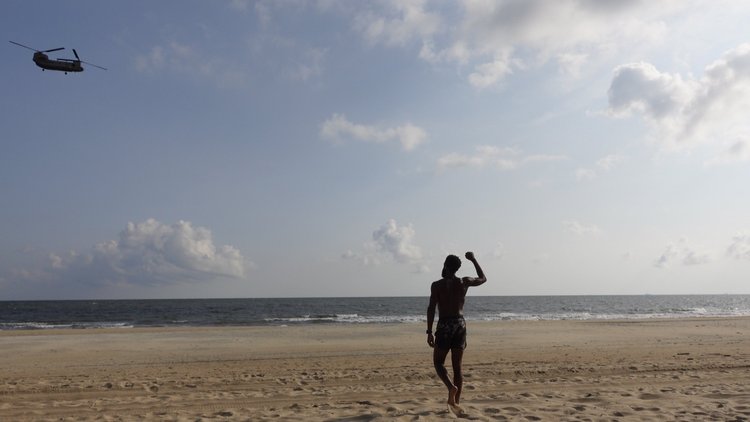
After a long workout today, I stood near the water and photographed my shadow stretching across the sand. It looked peaceful. The waves moved gently beneath an open sky, and someone unfamiliar with the area might have seen nothing unusual. But I knew what was missing. I’ve spent too many years here not to recognize the absence, and I’m tired of pretending that disappearance is something we’re supposed to accept without asking questions.

THE LAND WAS NEVER OURS
Massive construction trucks have been moving enormous boulders onto the shoreline. Riprap. Heavy stone used to stabilize eroding coastlines and absorb the force of waves. There is a reason for it. In March 2026, Norfolk allocated $1.8 million toward emergency stabilization along the 200 block of West Ocean View Avenue. The city’s own documentation described accelerated shoreline erosion despite two beach-renourishment projects during the previous five years. The U.S. Army Corps of Engineers subsequently documented a proposed riprap installation intended to protect a critically eroded bluff beneath six homes. [1][2]
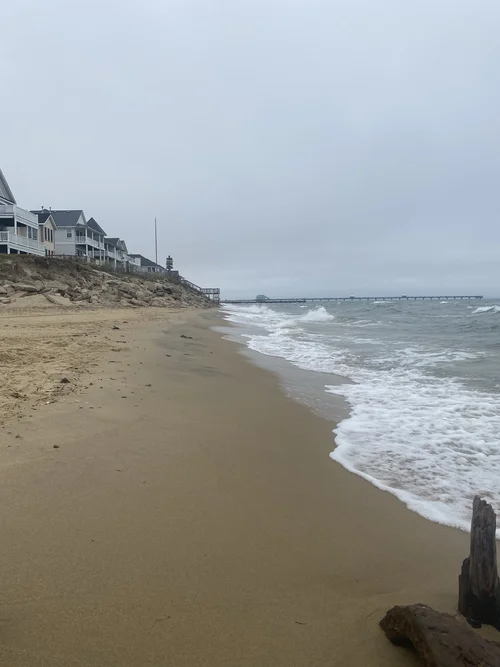
Think about that. We’ve reached a point where we’re bringing enormous rocks to defend houses built along an ever-changing shoreline. I understand the engineering, and I understand the concern for people’s homes and safety. I’m not indifferent to the families who may lose everything they’ve invested in those properties. But I have another question: who told us the shoreline would remain where we wanted it?
I respect Mother Nature. And who am I to tell her what to do? This is her land. The ocean was moving long before anyone constructed a home, installed a staircase, poured concrete, or decided that a particular section of coastline belonged to them. We build homes on stilts and imagine we’ve negotiated something permanent with the water. We purchase oceanfront property and begin speaking about the shoreline as though it’s an extension of our living room. But a deed can’t command the tide. Money can’t stop a current. Concrete can’t make the earth promise to remain still.
This isn’t an argument that we should abandon every coastal community. Human beings need places to live, and responsible protection matters. But there is something deeply arrogant about assuming nature must accommodate every decision we make. We build first, alter the landscape, defend our investments, and then act surprised when the water begins reclaiming its space. Mother Nature doesn’t recognize property lines. Maybe the lesson isn’t that she’s destroying what belongs to us. Maybe we’re finally being reminded that it never belonged to us in the first place.
WE HAVE TURNED THE WATER INTO A WASTE BIN
Erosion is one problem. What we’ve allowed to happen to the water is another. Over the past year, I’ve personally witnessed people bathing in the Chesapeake Bay while fully clothed. I’ve witnessed people defecating in the water. I’ve seen it with my own eyes. I don’t know everyone’s circumstances, and I’m not interested in humiliating individuals or turning human vulnerability into a spectacle. But I won’t pretend I haven’t seen what I’ve seen.
And the garbage. I’ve collected so many plastic bottles from Ocean View over the past decade that I couldn’t begin to count them. Bottles scattered across the sand after busy weekends. Food packaging. Discarded fishing line. Pieces of plastic that people step over as though the ground beneath their feet exists to receive whatever they no longer want. I’ve stopped in the middle of workouts to pick up what somebody else left behind, again and again and again.
There are cleanup teams. I’ve seen them, and their efforts matter. I respect the people doing that work. But why should the responsibility fall so heavily on the people willing to care? Why do we keep treating public spaces as though they’re disposable simply because nobody charges us admission?
I watch the birds feeding along the shoreline and hunting fish. I watch the fish moving beneath the water, the entire ecosystem continuing its ancient work around our interference. And I think about the fishing line, the abandoned nets, the plastic we leave behind. According to the National Oceanic and Atmospheric Administration, discarded fishing gear can continue trapping and killing aquatic animals long after its owners abandon it. They call this ghost fishing. NOAA has also documented how birds, fish, turtles, and other marine animals ingest plastic, sometimes suffering internal injury, starvation, or death. [3]
Plastic doesn’t have to remain a visible bottle to remain a problem. It breaks into smaller particles. Microplastics can be swallowed by marine organisms and may carry pollutants or release chemical additives. Researchers are still investigating the full consequences as those particles move through aquatic food webs. [4] Think about the cruelty of that. A bird doesn’t know what a polymer is. A fish doesn’t understand industrial manufacturing. An animal trapped in discarded fishing line cannot distinguish human negligence from the natural dangers it has evolved to survive.
We introduce things into their world that they have no biological preparation to understand, and then we call ourselves the intelligent species. Intelligence without responsibility is just another form of destruction.
THE BACTERIA HAVE A NAME

The water quality warnings along Ocean View aren’t imaginary. They’re documented. In July 2024, nine Ocean View beaches were placed under swimming advisories following bacterial testing. Another five received advisories that September. In 2025, documented warnings included North Community Beach in June and Captain’s Quarters Park in August. [5][6]
Then came 2026. On June 16, three Ocean View beaches received swimming advisories. On June 30, nine locations were affected simultaneously, including Ocean View Park, Sarah Constant Beach, and North Community Beach. On July 14, four locations received additional advisories. [7] The bacteria being monitored are called enterococci. These organisms serve as indicators of fecal contamination in recreational water. Their presence at elevated levels suggests an increased likelihood that other disease-causing microorganisms may also be present, raising the risk of gastrointestinal illness for swimmers. [7]
Let me say that plainly. People come to these beaches to swim, to bring their children, to cool themselves in the summer heat, and public-health officials have repeatedly found evidence of fecal contamination above state safety standards. Follow-up testing cleared those advisories. That matters. It would be inaccurate to claim the water remained unsafe every day, just as it would be inaccurate to declare that every individual who enters the water will become sick.
The documented warnings also don’t establish a steady annual increase in contamination. What they establish is recurrence: repeated episodes, a problem returning across multiple years and multiple stretches of shoreline. The exact sources of individual contamination episodes aren’t always identified. Rainfall, runoff, wastewater, human waste, and animal waste can all contribute to bacterial pollution. My own observations don’t prove what caused a particular laboratory result.
But the larger question remains: what are we doing to the water? How much contamination must be measured, how many warning signs must be posted, before we understand that access to a beach and access to clean water are not the same thing? And why have we become so comfortable living with the difference?
THESE WATERS WERE NEVER EMPTY
There’s another reason Ocean View is sacred to me: history. Across these waters, at Old Point Comfort in present-day Hampton, the White Lion arrived in August 1619 carrying captive Africans who had been seized from the Spanish slave ship São João Bautista. The National Park Service identifies this as the first documented arrival of enslaved Africans in English-occupied mainland North America. Those men and women had been violently taken from their homeland, from the kingdom of Ndongo in present-day Angola. [8]
I think about that history when I stand beside this water. I think about my ancestors, the people who crossed the Atlantic against their will, whose lives were stolen, whose names were erased, whose labor built wealth they would never possess. I think about the blood. The tears, pain, survival. I don’t need to stand at a monument to remember that this region holds an extraordinary history of human suffering and resistance. I carry that awareness with me.
The White Lion arrived at Point Comfort, not this particular stretch of Ocean View sand. The distinction matters historically. But these are connected waters, part of the same Hampton Roads landscape through which the consequences of 1619 continue to echo. For some people, this is just a beach. For me, it’s a place where geography and memory refuse to remain separate.
There’s something deeply unsettling about watching a landscape connected to so much history become another casualty of carelessness and disregard. We talk about heritage while contaminating the waters around it. We commemorate the past while treating the ground beneath us as disposable. We celebrate survival while destroying the ecosystems that sustain life. Most people walk right past it. I can’t. I never spend a day here without respecting what this place means. Not one.
THE PEOPLE ARE PART OF THE LANDSCAPE
When I say Ocean View is disappearing, I’m not only talking about sand. I’m thinking about the people: the older women who embrace me when they see me, the men who stop to talk and ask how I’ve been even after months apart, the conversations with people living outside who understand this shoreline in ways that tourists and occasional visitors may never comprehend. I’m thinking about the young people I’ve watched grow older, the familiar faces, the relationships that exist nowhere else in my life.
You cannot measure those things in cubic yards of sand. You cannot replace them with riprap. You cannot put a dollar figure on the meaning of returning to a place where somebody remembers who you were ten years ago. And I don’t want to hear that public spaces only have value when someone can build something profitable on them. Some places hold communities together without ever making a sale. Some places keep people alive in ways that never appear on a balance sheet.
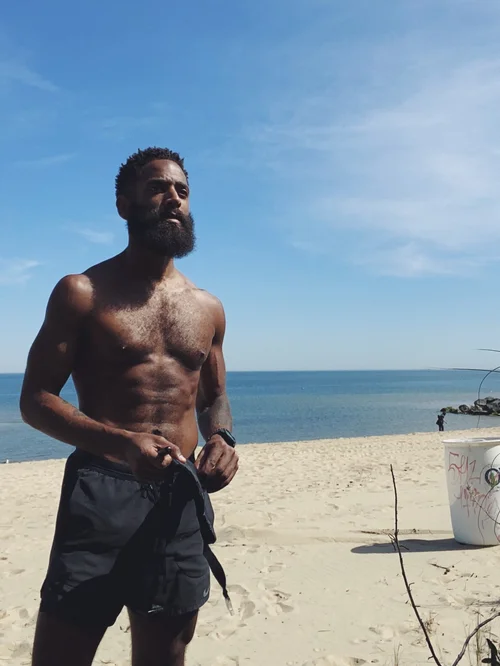
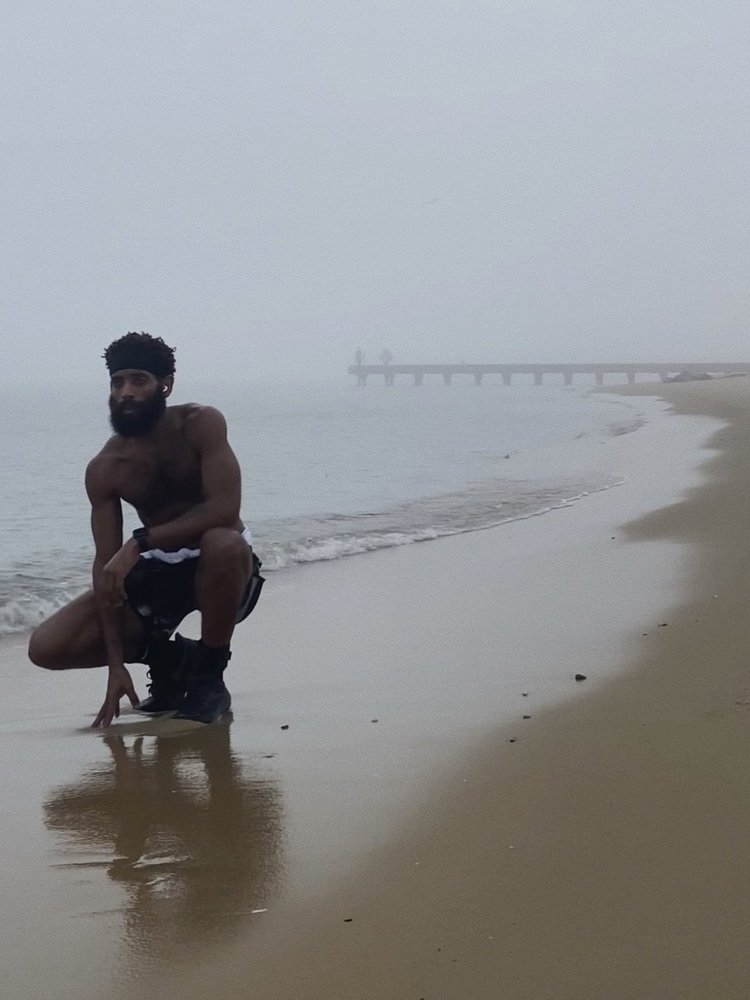
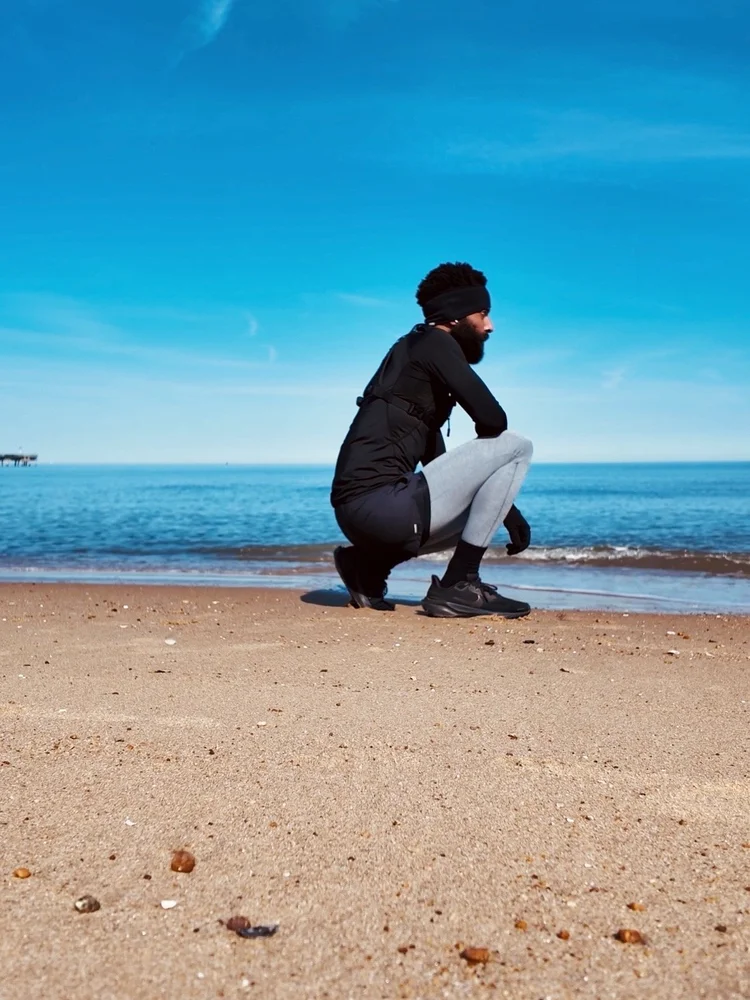
Ocean View has given me more than I could explain to someone who only knows it from a map. It’s where I’ve pushed my body beyond limitations I once believed were permanent, where I’ve worked through pain, exhaustion, anger, and grief, where I’ve watched the sun come up over the water and felt grateful simply to be alive to witness it.
My transformation happened here. Not in a luxury gym or inside a building surrounded by mirrors, but on sand, beneath open sky, beside water that never stopped moving. I have the photographs. I have the footage. I can show you the physical transformation over the years. But what I can’t place inside a photograph is everything this shoreline helped me survive. That’s what hurts.
MOTHER NATURE IS NOT ASKING OUR PERMISSION
I’ve been watching construction activity around the shoreline and nearby bridges. Heavy machinery, rock, infrastructure being maintained, repaired, reinforced. I don’t claim to know the condition of every structure or the adequacy of every engineering decision. That requires inspections, measurements, and expertise. But I know what I see along the beach: cliffs, exposed slopes, water reaching places where I once stood, and massive stones being moved into position.
I have a feeling that difficult storms are ahead. That’s my personal apprehension, not a meteorological forecast. Living beside this water long enough teaches you to respect its power without pretending you can predict every season. Still, I wonder how much more this shoreline can withstand, and I refuse to blame Mother Nature for everything human beings have done.
She didn’t manufacture plastic bottles. She didn’t abandon fishing line. She didn’t decide where every building should stand. She didn’t create our culture of convenience, consumption, and disregard. Coastal erosion has natural causes, intensified in many places by human alterations to shorelines and changing environmental conditions. Bacterial contamination and discarded waste are different problems with different causes. They shouldn’t be confused, but they meet in the same place, here where I’m standing.
Sometimes it feels as though Mother Nature is delivering a message. You were given somewhere to rest, somewhere to breathe, somewhere to bring your children, somewhere to watch birds feed, fish swim, and sunlight move across the water. And you couldn’t even respect it. Now the shoreline is changing, and we’re scrambling to defend what we built.
I don’t literally believe the earth is choosing to poison people in retaliation. Human contamination has human causes, and the natural world doesn’t require our moral explanations. But as a man of faith, I believe we’re responsible for how we treat creation, and I believe there’s a kind of judgment contained in consequences. Not every disaster is punishment. Not every retreating shoreline is a message from God. Sometimes a storm is simply a storm, and erosion is simply erosion. But the way we respond to those realities says something about us. Our refusal to take responsibility says even more.

WHAT REMAINS
I returned to the beach today after a long workout and took a photograph of my shadow in the sand. For a moment, I was standing still, watching the water move. I thought about the photograph from 2019 and how much wider the beach was then. I thought about the place where I used to stop and do pushups, about the people who know me here and the conversations I may never have anywhere else. I thought about the White Lion, the birds, and all the bottles I’ve picked up only to return and find more. I thought about the homes standing above an eroding shoreline, the people inside them, and the immense machinery now being deployed to defend the land.
I felt angry. I felt sad. And beneath all of it, I felt grateful. Grateful that I’ve been able to know this place deeply enough to recognize what we’re losing. I don’t believe loving nature means demanding that she remain unchanged. Quite the opposite. To love the natural world is to understand that it exists beyond our ownership, beyond our preferences, beyond our brief human lives. The shoreline will continue changing whether I return tomorrow or never come back. I accept that.
What I cannot accept is our willingness to damage the places that sustain us and then pretend the consequences have nothing to do with our behavior. The erosion may be inevitable in some form. The garbage isn’t. The disregard isn’t. The careless contamination isn’t. We have choices about those things. And for all our intelligence, all our engineering, all our wealth and technology, we’re still struggling with the simplest obligation imaginable.
Respect the ground you stand on. Respect the water that sustains life. Respect the creatures that were here before you. Respect the people who will come after you.
I’m not asking Mother Nature to give me my beach back. I’m asking human beings to stop treating it like it never mattered. Because it mattered to me. It still does. And I will remember what stood here, even after the water has taken the last familiar stretch of sand.
The land was never ours to command. But how we cared for it was always our responsibility.

Sources and documentation
[1] City of Norfolk, March 24, 2026 Capital Improvement Budget Amendment. Emergency funding and accelerated erosion in West Ocean View. Adoption confirmed in March 24, 2026 City Council minutes, Ordinance 50315.
[2] U.S. Army Corps of Engineers, 200 Block Ocean View Shoreline Stabilization Notice, April 2026. Riprap, erosion, and protection of existing residences. Public notice published April 24, 2026; the proposed work is a City of Norfolk project subject to USACE Section 408 review.
[3] NOAA Marine Debris Program, Wildlife Entanglement and Ghost Fishing and Plastic Ingestion.
[4] NOAA National Ocean Service, What Are the Impacts of Microplastics?.
[5] City of Norfolk, July 2, 2024 Ocean View Swimming Advisories and September 4, 2024 Swimming Advisories.
[6] Virginia Department of Health, North Community Beach Advisory, June 10, 2025 and Captain’s Quarters Park Advisory, August 19, 2025.
[7] Virginia Department of Health, Ocean View Advisories: June 16, 2026, June 30, 2026, and July 14, 2026. Follow-up notices in the 2026 regional news archive document these advisories being lifted on June 17, July 1, and July 15, respectively.
[8] National Park Service, Arrival of the First Africans in 1619 and 400 Years of African American History.